Business Expenses for the Self-Employed
If you work for yourself, you pay tax on your profit, not your takings. This plain-English guide explains which costs you can deduct, the £1,000 trading allowance, the flat rates you can use for working from home and for vehicles, and the records you need to back up your claims, with links to the official guidance at the end.
The 5 key points
1. Only costs wholly and exclusively for the business count
You can deduct day-to-day running costs that you incur only to earn your business profits. If something is used for both business and private purposes, you can only claim the business part.
2. Items that last two years or more are capital
Equipment and vehicles you keep for two years or more are capital expenditure. How you get relief depends on your accounting method: capital allowances under traditional accounting, but under the cash basis most equipment is deducted as an expense instead (see Revenue or capital? below).
3. The £1,000 trading allowance is an alternative to expenses
If your gross trading income is £1,000 or less you may not need to tell HMRC at all. Above that, you can deduct the £1,000 allowance instead of your actual expenses, but never both.
4. Simplified expenses are optional flat rates
You can use flat rates for working from home (£10 to £26 a month) and for business mileage instead of working out actual costs. Once you choose a method for a vehicle you must keep using it for that vehicle.
5. Keep records to support every figure
Set up a record keeping system from the start, keep it up to date and keep receipts, invoices and bank statements to back up your expenses, even if you only report a single total figure.
What is an allowable expense?
Business expenses are the day-to-day running costs of your business, spent to earn your business profits. You pay tax on what is left after you take them away from your income.
The wholly and exclusively test
Things to watch out for
- Private use: anything you use for both business and personal reasons, such as a phone or car, is only partly allowable.
- Fines: speeding tickets and parking fines are never allowable, even if you were on business at the time.
- Lunch: your everyday lunch is not a business expense. You can claim meals only on a journey outside your normal business pattern, or when you stay away overnight.
Revenue or capital?
How you get relief depends on whether a cost is a running cost or something you buy to keep and use in the business.
Day-to-day running costs such as premises costs, phone bills and stationery. You deduct them from your income in the year you have them.
Items you keep and use for two years or more, such as a van, tools or a computer. Whether you claim capital allowances on them depends on whether you use the cash basis or traditional accounting (see below).
Cash basis or traditional accounting
The method you use to record your income and expenses affects when you claim them.
Record money only when it comes into or goes out of your business. This is now the default method for most sole traders.
Record income and expenses in the tax year they relate to, whether or not you have been paid or have paid yet. You must opt in to use it.
Capital allowances depend on your method. Under traditional accounting you claim capital allowances on equipment and vehicles. Under the cash basis you deduct most equipment, including vans, as an expense when you pay for it; cars are the main exception and still go through capital allowances.
The £1,000 trading allowance
Each tax year (starting 6 April) you can have up to £1,000 of tax-free trading income from self-employment. It is optional.
Rising to £3,000 from April 2027: the Autumn Budget 2026 announced that the trading allowance will increase from £1,000 to £3,000 from 6 April 2027 (the 2027 to 2028 tax year), subject to legislation. The £1,000 limit still applies until then. The £1,000 property allowance is not changing.
When you might still register
Even with income of £1,000 or less, you may want to register and file a return if:
- your expenses are more than your income and you want to claim loss relief or carry the loss forward
- you want to pay voluntary Class 2 National Insurance to build entitlement to benefits such as the State Pension
- you are a construction subcontractor and want to claim back overpaid tax
- you need to show you are self-employed for Maternity Allowance or Tax-Free Childcare
You cannot use the allowance for income from
- a company you or a connected person controls
- a partnership you are a partner in
- your employer, or your spouse's or civil partner's employer
Common business expenses
These are the main expense boxes on the self-employment pages of the tax return.
Cost of goods bought for resale
If you sell goods, you claim the cost of the stock you actually sold in the year, not everything you bought.
Car, van and travel
- Bus, taxi, train, plane and ferry fares for business journeys
- Hotel rooms and meals when you are away overnight on business
- Vehicle costs: see the two motoring methods below
- Not fines, and not ordinary travel between home and a permanent workplace
Premises costs
- Business premises: heating, lighting, rent, business rates and insurance
- Working from home: a proportion of heating, lighting, insurance, mortgage interest or rent, and cleaning
Accountancy, legal and other professional fees
- Accountants' and solicitors' fees
- Professional indemnity and public liability insurance
- Subscriptions to professional bodies on HMRC's approved list (List 3)
Phone, stationery and office costs
A mobile bought only for business is fully allowable. For a phone or landline used privately too, claim the business proportion only. If that is hard to work out, take a fair and reasonable approach and keep a note of how you did it.
Other allowable costs
- Advertising and marketing
- Uniforms, protective clothing and costumes (not everyday clothing)
- Trade and professional journals
- Training that updates skills you already use in the business
Simplified expenses
Simplified expenses let you use flat rates instead of working out your actual business costs. They are optional: it is up to you whether they save you time or tax.
Working from home
You have two choices. You can work out the business share of your household bills, for example by the number of rooms and how long a room is used for business, keeping copies of the bills. Or, if you work at least 25 hours a month from home, you can claim a flat rate based on your hours.
Keep a record of the hours you spend on core business activities each month.
Motoring: two methods
Keep records of running costs (insurance, servicing, tyres, MOT, road tax, repairs, breakdown cover) and your mileage at the start and end of the period. Claim the business percentage of the running costs. For the vehicle itself, claim capital allowances, unless you use the cash basis and it is a van, which you deduct as an expense instead.
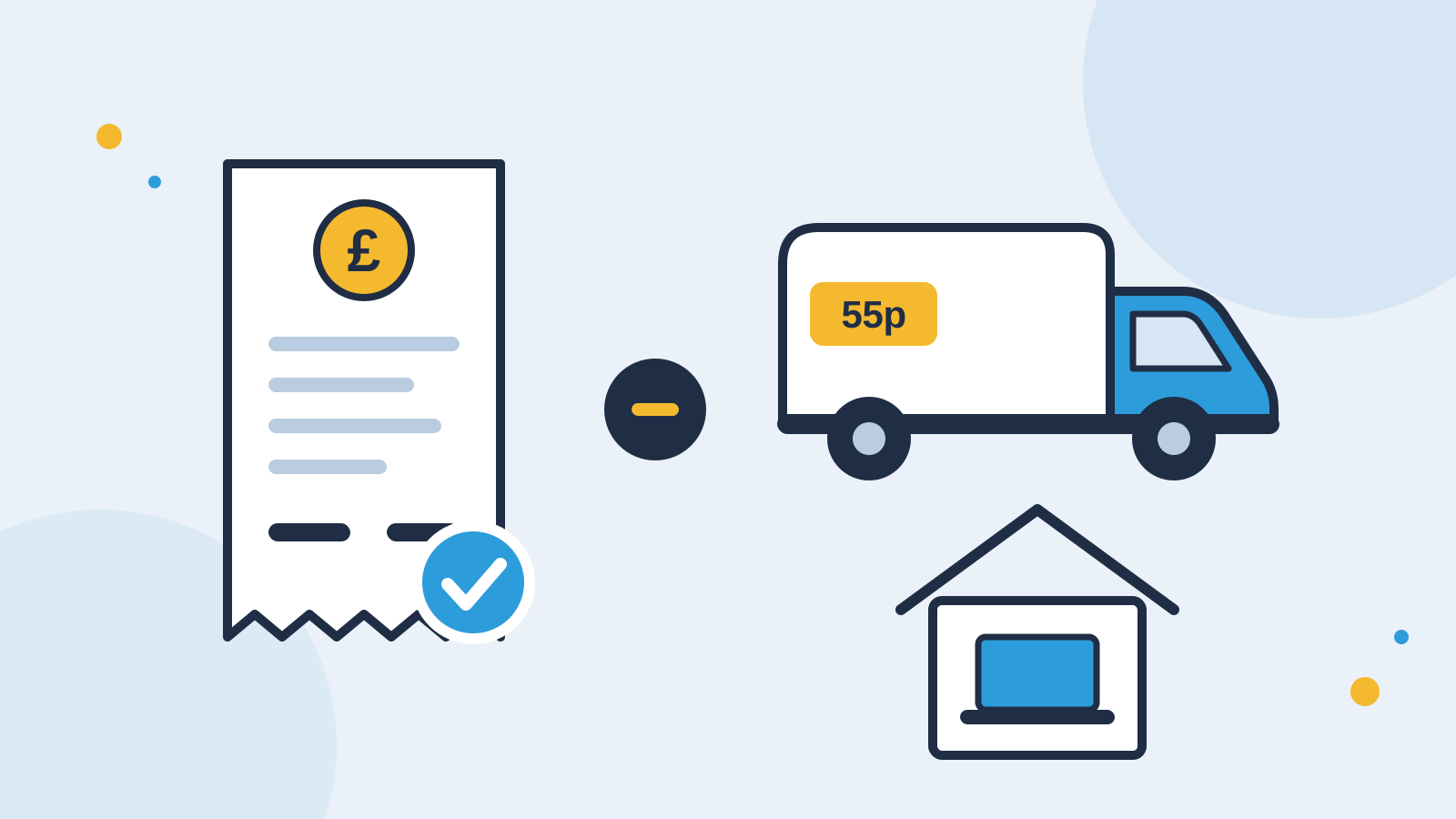
Cars and vans: 55p a mile for the first 10,000 business miles in the year (45p before 6 April 2026), then 25p a mile. Motorcycles: 24p a mile. No running cost records needed, and no capital allowances.
Worked example: Alan's van
Alan drives 20,000 miles in his van over the accounting period, 15,000 of them on business, and his running costs are £6,000.
Living in your business premises
If you live in your business premises, such as a guest house or bed and breakfast, there is a flat rate scheme for the private use of the premises.
Record keeping
Good records help you fill in your tax return, show how your business is doing and back up every expense you claim. For most businesses a simple record book or spreadsheet is enough; larger businesses may need more.
If you report a single total for expenses
If your turnover is below the VAT registration threshold you can enter your expenses as one total figure on your return (often called three-line accounts). You still need the same records to support that total.
For more detail, see our guide to record keeping for the self-employed.
What has changed, and what is coming
Higher mileage rate from 6 April 2026
The flat rate for cars and vans rose from 45p to 55p a mile for the first 10,000 business miles, the first increase since 2011. Miles over 10,000 stay at 25p, and motorcycles at 24p.
Basis period reform is complete
Every sole trader now reports profits on a tax year basis. If your accounting year does not end on 5 April or 31 March, you need to apportion profits from two accounting periods.
Making Tax Digital for Income Tax
Since 6 April 2026, sole traders and landlords with qualifying income over £50,000 must keep digital records and send quarterly updates. The threshold falls to £30,000 from April 2027 and £20,000 from April 2028, so good expense records now will make the switch easier.
Trading allowance rising to £3,000
From 6 April 2027 the trading allowance increases from £1,000 to £3,000, as announced in the Autumn Budget 2026. More people with small side incomes will not need to tell HMRC, and those above it can deduct £3,000 instead of their actual expenses.
Official guidance
- Expenses if you're self-employed
- Simplified expenses if you're self-employed
- Increase to mileage rates from 6 April 2026
- Tax-free allowances on property and trading income
- Cash basis
- Approved professional organisations and learned societies (List 3)
- Business records if you're self-employed
- Income Tax: increasing the trading allowance
Not sure what you can claim? We can review your expenses, compare the flat rates with your actual costs, keep your records in Xero and get you ready for Making Tax Digital.
Talk to us about your expensesThis guide is general information based on HMRC's published guidance, and is not advice for your specific circumstances. Rules change, so check the official guidance or speak to us before acting.