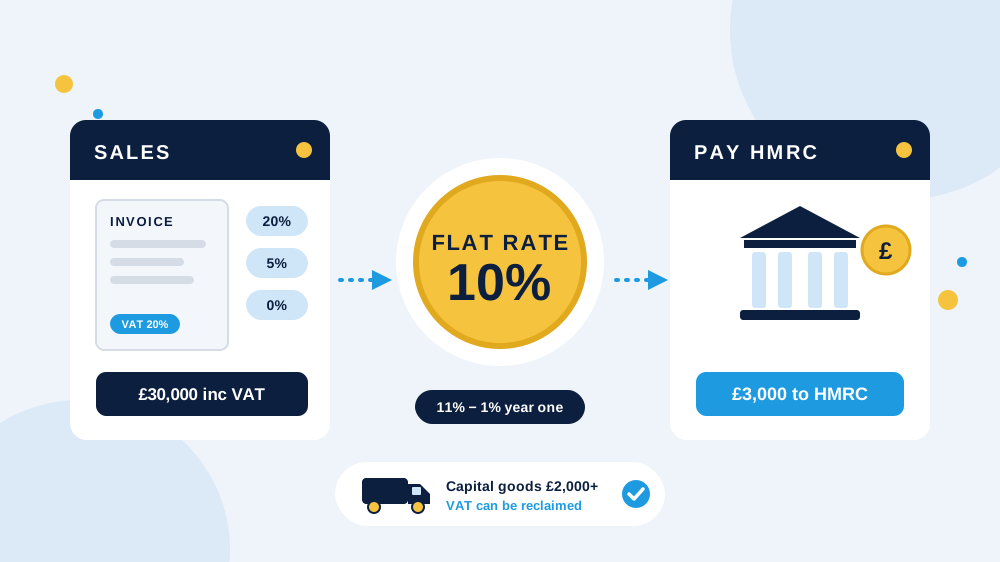
VAT Flat Rate Scheme: How It Works
The Flat Rate Scheme can make VAT simpler for small businesses: instead of tracking the VAT on every purchase, you pay HMRC a fixed percentage of your turnover. This plain-English guide covers who can join, how flat rate turnover works, how to choose the right rate (including the 16.5% limited cost business rate), the first-year discount, when you can still reclaim VAT on capital goods, and how to fill in your VAT Return. It is based on HMRC's webinar "VAT: using the Flat Rate Scheme" and HMRC's published guidance, with worked examples and links to the official sources at the end.
The 5 key points
1. You pay HMRC a fixed percentage of your VAT-inclusive turnover
You still charge your customers VAT at the standard, reduced or zero rate as normal. The flat rate only changes how much you pay over to HMRC, and in return you generally can't reclaim the VAT on your purchases.
2. Join at £150,000, leave at £230,000
You can join if you're VAT registered and expect your VAT taxable turnover in the next 12 months to be £150,000 or less, excluding VAT. You must leave once your VAT-inclusive turnover goes over £230,000.
3. Check the limited cost business test every period
If you spend very little on goods, you must use the 16.5% rate whatever your trade. This applies to every business on the scheme, not just new ones, so check it for every VAT return.
4. Take 1% off in your first year of VAT registration
The discount runs until the day before the first anniversary of your VAT registration, not of the day you joined the scheme. Join late in your first year and you'll get less of it.
5. Capital goods of £2,000 or more are the exception
You can still reclaim the VAT on a single purchase of capital goods costing £2,000 or more including VAT, such as a van. Several smaller purchases that add up to £2,000 don't count.
What is the Flat Rate Scheme?
Under standard VAT accounting you charge VAT on your sales (output tax), reclaim the VAT on your business purchases (input tax) and pay HMRC the difference, or claim a repayment. The Flat Rate Scheme replaces that calculation with a single percentage.
Output tax minus input tax equals your payment to HMRC, or your repayment. You need VAT records for every sale and every purchase.
VAT-inclusive turnover multiplied by your flat rate percentage equals your payment to HMRC. You don't usually reclaim VAT on purchases.
Flat rate turnover
Your flat rate is applied to your flat rate turnover. This is your total turnover including VAT, and it covers all your supplies, even the ones that carry no VAT.
Don't confuse it with VAT taxable turnover
The £150,000 joining limit uses VAT taxable turnover instead: standard, reduced and zero-rated sales, excluding VAT, and leaving out exempt supplies. The £230,000 leaving limit uses VAT-inclusive turnover, including exempt supplies.
Is the scheme right for you?
You can join the Flat Rate Scheme if you're a VAT-registered business and you expect your VAT taxable turnover in the next 12 months to be £150,000 or less, excluding VAT. Whether it is a good idea depends on what you sell and what you spend.
You want fewer records to keep, you can use the first-year discount, and you like knowing the fixed rate you'll pay. Service businesses with few VAT-able costs often benefit.
You usually get VAT repayments, or most of your sales are zero-rated or exempt. The flat rate is charged on those sales too, so you could pay HMRC VAT you never collected.
Joining and leaving the scheme
Not expecting to stay over £230,000?
If your turnover goes over £230,000 but you don't expect your VAT taxable turnover to stay at that level, HMRC may let you remain on the scheme. Check VAT Notice 733 or speak to us before assuming you can stay.
Turnover methods
There are three ways to work out your flat rate turnover for each period. Use the one that fits how you trade.
Working out your flat rate
You don't charge your customers your flat rate. You charge VAT at 20%, 5% or 0% as usual, and use the flat rate only to work out what you pay HMRC.
What counts as goods for the limited cost test?
Goods are movable items or materials used only in your business, and can include gas and electricity. Don't include services, travel and accommodation, food and drink for you or your staff, vehicle costs including fuel (unless you're in the transport business), rent, internet, phone bills and accountancy fees, gifts and promotional items, goods you'll resell or hire out (unless that's your main business), training and memberships, or capital items such as laptops, phones and office equipment.
Example: Neeta and the limited cost test
Goods £200, VAT-inclusive turnover £9,000. Goods are just over 2% of turnover but under £250 for the quarter, so Neeta is a limited cost business and uses 16.5%.
Goods £1,000, VAT-inclusive turnover £9,000. Goods are more than 2% of turnover and more than £250, so Neeta uses the flat rate for her type of business.
Example: Paul's first VAT period
Paul registered for VAT and joined the Flat Rate Scheme straight away. His type of business has an 11% flat rate, and he is in his first year of VAT registration, so he uses 10%.
When the first-year discount ends
Registers for VAT and joins the scheme on 1 June. He gets the 1% discount for a full 12 months, until 31 May the following year.
Registers for VAT on 1 April but joins the scheme part way through the year. Her discount still ends on 31 March, the day before her VAT registration anniversary.
More than one business activity
Jenny runs a B&B and decides to open a nail bar in a small room at the property. She can stay on the Flat Rate Scheme as long as her total VAT-inclusive turnover stays within the limits, but she can only use one flat rate.
The B&B is Jenny's main business activity, so this is her flat rate.
Not used. Jenny applies 10.5% to the turnover from both businesses.
Does Jenny charge her customers 10.5% VAT?
No. In HMRC's live poll, 75% of attendees got this right. Jenny charges her customers VAT at the normal rates and uses 10.5% only to work out what she pays HMRC.
Reclaiming VAT on capital goods
On the Flat Rate Scheme you don't normally reclaim VAT on purchases. The exception is capital expenditure goods, such as vehicles, machinery and equipment you'll use in the business over time, bought in a single purchase costing £2,000 or more including VAT.
Goods that don't qualify
You can't treat goods as capital expenditure goods if you buy them to resell, to build into other goods you supply, to use up completely within a year, or to lease, let or hire out to earn income.
Two examples
Cost £8,000 plus VAT of £1,600, bought in one purchase from one supplier. Paul can reclaim the £1,600.
Two double beds (£1,200, January), two single beds (£650, February) and three wardrobes (£690, April) total £2,540, but they were separate purchases and none cost £2,000 on its own.
Records to keep
You still need to keep VAT records and issue VAT invoices as normal, including copies of your sales invoices and your purchase invoices. On top of that, for each VAT period keep a record of:
Filling in your VAT Return
A few boxes work differently on the Flat Rate Scheme.
Who sends the return?
In HMRC's live poll, 47% of attendees said they submit their own VAT returns, 36% use an accountant, 9% a finance department and 6% an agent. Whoever files it, the flat rate turnover and rate used must be worked out correctly every period.
Official guidance
- VAT Flat Rate Scheme
- VAT Flat Rate Scheme: how much you pay (flat rates by type of business)
- Work out your flat rate, including the limited cost business test
- Join or leave the Flat Rate Scheme
- VAT Notice 733: Flat Rate Scheme for small businesses
- Charge, reclaim and record VAT
- Our guide: VAT accounting schemes (cash, flat rate and annual accounting)
- Our guide: VAT basics and the VAT Return
Not sure whether the Flat Rate Scheme would save you money? We can run the numbers on your actual sales and purchases, check the limited cost test each quarter and handle your VAT returns, for businesses across Paisley and Renfrewshire.
Talk to us about VATThis guide is general information based on HMRC's published guidance and webinar, and is not advice for your specific circumstances. Rules change, so check the official guidance or speak to us before acting.